
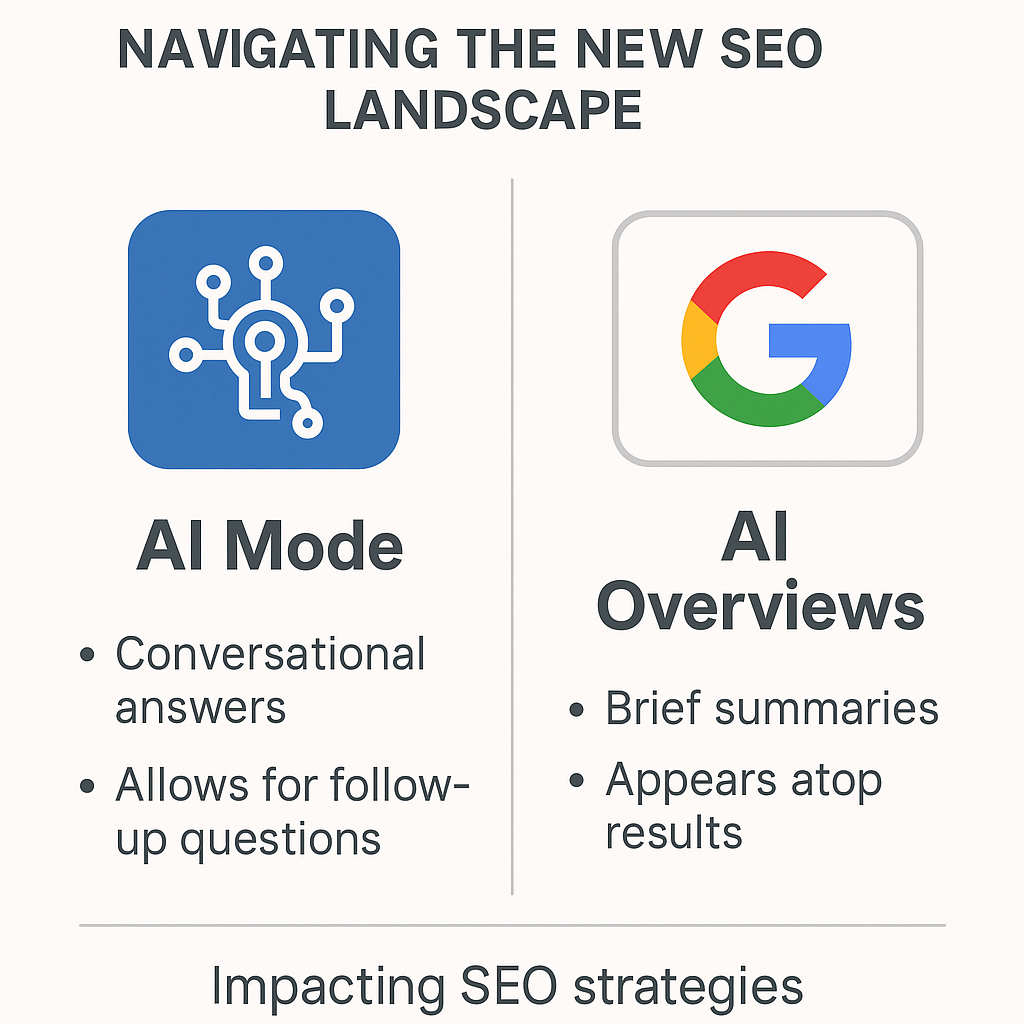
Google AI Mode vs AI Overviews represents a pivotal transformation in how users interact with search results, and it’s already reshaping the SEO landscape. With Google’s AI Mode now live for millions of users, marketers and businesses must understand how it differs from AI Overviews—and more importantly, how it impacts click-through rates and visibility in search.
Understanding AI Mode vs. AI Overviews
AI Overviews: These are concise summaries generated by AI, appearing at the top of search results to quickly address user queries. While they offer immediate answers, they often lead to reduced click-through rates as users find the information they need without visiting external websites
AI Mode: This feature extends beyond summaries, delivering in-depth, conversational answers that allow for follow-up questions. It utilizes advanced reasoning and multimodal capabilities, enabling users to interact with search results in a more dynamic manner. AI Mode is particularly adept at handling complex queries, offering synthesized information from multiple sources.
Implications for SEO and Click-Through Rates
The advent of AI Mode has led to a noticeable decline in traditional organic traffic. By providing comprehensive answers within the search interface, users have less incentive to click through to external websites. This shift challenges the conventional SEO model, where higher rankings typically equated to increased traffic
Moreover, AI Mode’s ability to answer complex, multi-part questions means that content must be more authoritative and comprehensive to be featured. Brands not cited within AI-generated responses risk diminished visibility, emphasizing the need for content that demonstrates expertise and trustworthiness.

Strategies to Adapt Your SEO Approach
To remain competitive in this evolving landscape, consider the following strategies:
1. Enhance Content Authority and Trustworthiness
Focus on creating content that showcases your expertise and builds trust. This includes incorporating up-to-date information, citing reputable sources, and addressing user intent comprehensively. Implementing E-E-A-T (Experience, Expertise, Authoritativeness, Trustworthiness) principles can improve your content’s chances of being featured in AI responses .
2. Optimize for Conversational Queries
With AI Mode’s conversational nature, tailoring your content to address natural language queries can enhance visibility. Utilize FAQs, structured data, and schema markup to align with how users interact with AI-driven search features .
3. Monitor and Adjust to Traffic Changes
Given the potential for decreased click-through rates, it’s essential to monitor your website analytics closely. Identify which pages are experiencing traffic declines and adjust your content strategy accordingly. Consider diversifying traffic sources beyond organic search, such as social media and email marketing .
4. Embrace Generative Engine Optimization (GEO)
GEO involves optimizing content specifically for AI-driven search engines. This includes structuring content to be easily interpretable by AI, using clear headings, bullet points, and concise language. By aligning with AI preferences, your content is more likely to be included in AI-generated responses.
Preparing for the Future of Search
As AI Mode continues to evolve, it’s crucial to stay informed about changes and adapt your strategies accordingly. Engage with industry updates, participate in SEO communities, and consider consulting with SEO professionals who specialize in AI-driven search optimization.
By proactively adjusting your SEO approach to accommodate AI Mode, you position your brand to maintain visibility and relevance in an increasingly AI-centric search environment.