
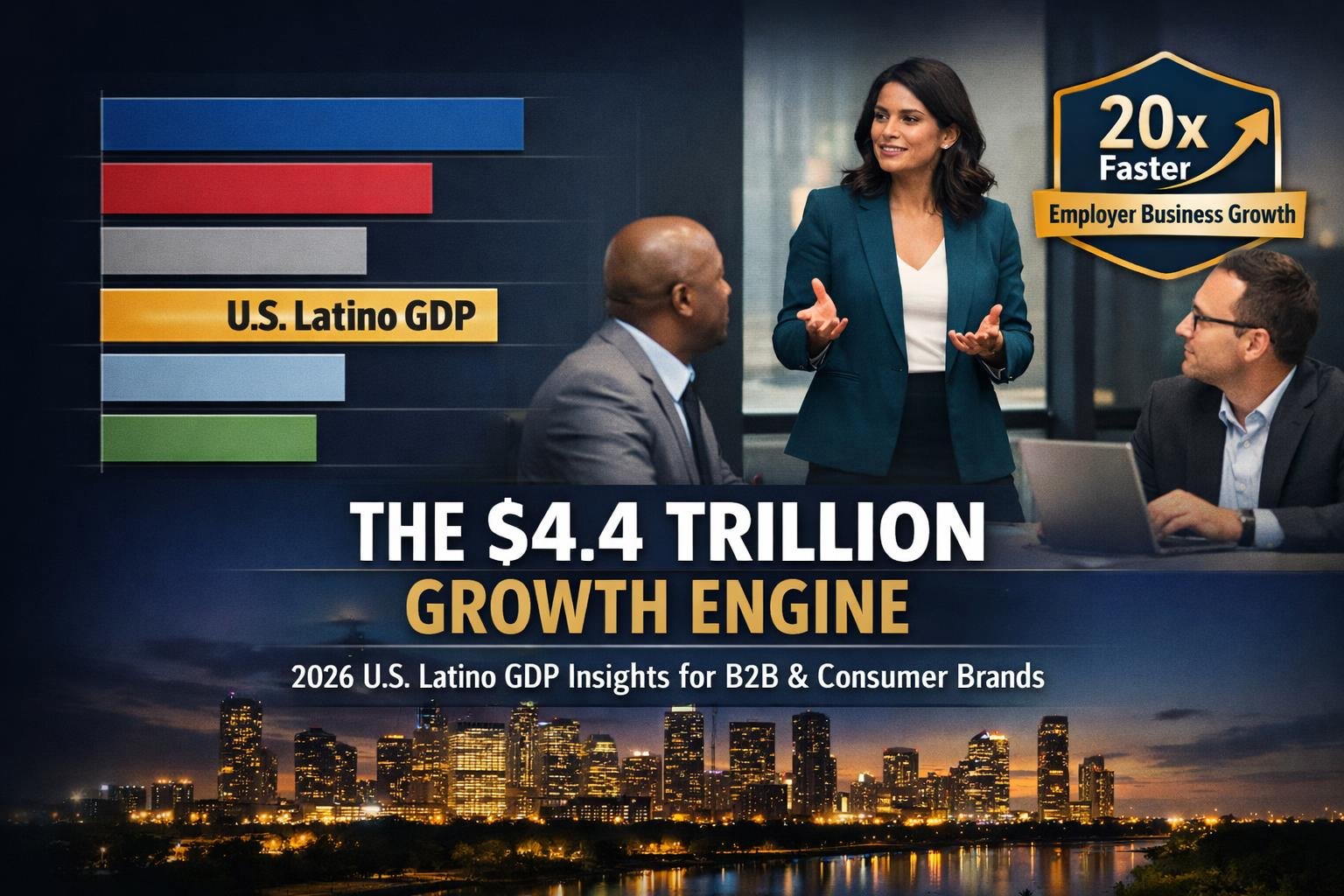
When marketing executives and business owners evaluate growth opportunities, Hispanic audiences are still too often categorized as a secondary demographic segment or a seasonal campaign line item. The macroeconomic data tell a fundamentally different story. Rather than operating at the margins of the American economy, U.S. Latinos are one of the primary engines sustaining national consumer spending, workforce expansion, and business creation.
According to the 2026 U.S. Latino GDP Report, authored by economists and demographers at California Lutheran University’s Center for Economic Research & Forecasting (CERF) and UCLA’s Center for the Study of Latino Health and Culture (CESLAC), total U.S. Latino economic output reached $4.4 trillion in 2024 (the latest year of complete U.S. Bureau of Economic Analysis Input-Output data). Measured as a standalone national economy, U.S. Latinos now represent the equivalent of the fourth-largest GDP in the world—surpassing Japan ($4.03 trillion), India ($3.91 trillion), and the United Kingdom ($3.64 trillion), and trailing only the overall United States, China, and Germany.
Building on those federal accounting benchmarks, the 2026 LDC U.S. Latino Economic Impact Report – Part Two—produced by the Latino Donor Collaborative (LDC) and the W. P. Carey School of Business at Arizona State University—estimates in its 2026 nowcast that the U.S. Latino economy has expanded to $5.1 trillion in GDP, including an estimated $940 billion in Texas alone.
For CMOs, commercial leaders, and business owners, the numbers inside these reports offer a clear look at where U.S. demand is actually expanding—both in consumer categories and in business-to-business (B2B) markets.
The Velocity Behind the $4.4 Trillion Milestone
While the sheer size of the U.S. Latino economy commands attention, its rate of expansion is even more significant for strategic planning. The Latino GDP Project documents that real (inflation-adjusted) U.S. Latino GDP grew 6.4% in 2024, compared to 2.4% for non-Latino GDP. Across the five-year period from 2019 to 2024, real U.S. Latino GDP grew at an average annual rate of 5.4%—2.9 times faster than the non-Latino component of the U.S. economy and faster than any of the world’s 10 largest national economies, including India (5.2%) and China (4.9%).
Even though Hispanics represent 20.0% of the U.S. population (68.1 million people in the 2024 Census vintage), they drove nearly 30% of real U.S. GDP growth between 2019 and 2024. The 2026 LDC U.S. Latino Economic Impact Report – Part One notes that in 2024 alone, U.S. Latinos accounted for 28.2% of all U.S. economic growth.
Crucially, the researchers emphasize that this momentum is not merely a byproduct of immigration. Census Bureau vital statistics cited in the 2026 U.S. Latino GDP Report show that U.S. Latino population growth is driven predominantly by domestic births. Between 2020 and 2024, cumulative Latino natural population increase (births minus deaths) added 3.2 million people, whereas the non-Latino population experienced a natural decline of 1.3 million. Furthermore, Latinos entering the U.S. workforce today are overwhelmingly second- and third-generation Americans.
What Drives Hispanic Purchasing Power: Income, Education, and Household Formation
A common misconception in corporate planning is that Hispanic market growth is strictly a volume play driven by headcount. In reality, per-capita human capital gains and wage growth are reshaping the profile of the Hispanic consumer.
According to the 2026 U.S. Latino GDP Report, U.S. Latino personal consumption reached a record $3.0 trillion in 2024 (and is nowcast at $3.2 trillion in 2026 by the LDC and Arizona State University). To put $3.0 trillion in perspective, U.S. Hispanic consumption alone is 25% larger than the entire economy of Italy ($2.37 trillion), 32% larger than Canada’s economy ($2.24 trillion), and 7% larger than the entire state GDP of Texas ($2.77 trillion in 2024).
Five verified structural drivers explain why Latino consumption grew 81.5% in real terms from 2010 to 2024—2.6 times faster than non-Latino consumption (31.7%):
- Rapidly Rising Educational Attainment: From 2010 to 2024, the number of U.S. Latinos holding a bachelor’s degree or higher increased by 144.5%, growing 3.2 times faster than non-Latinos (44.8%). In 2024 alone, the number of college-educated Latinos grew 8.5%, compared to 3.2% for non-Latinos.
- Accelerating Real Wage Growth: Between 2019 and 2024, inflation-adjusted wage and salary income for U.S. Latinos surged 29.3%, compared to just 1.3% for non-Latinos. Over the longer 2010–2024 window, real Latino wage and salary income grew 74.1% (3.4 times faster than non-Latino income).
- Record Labor Force Participation: In 2024, 35.1 million Latinos participated in the U.S. labor force, with a labor force participation rate of 69.0%—6.2 percentage points higher than the non-Latino rate (62.8%), marking an all-time high participation premium. With a median age of 31.2 years (versus 41.4 for non-Latinos), Latinos accounted for 56.5% of total U.S. labor force growth since 2010.
- Outsized Household Formation: From 2010 to 2024, the number of Latino households expanded by 52.4%, which is 4.7 times faster than non-Latino household growth (11.1%). Despite making up one-fifth of the population, Latinos generated 38.3% of all new U.S. households since 2010. The LDC’s Part One report further notes that in 2025, Latino households accounted for 92.6% of net new U.S. household formation.
- Sustained Homeownership Gains: The number of Latino homeowners rose 64.6% between 2010 and 2024 (5.7 times faster than non-Latinos), pushing the Latino homeownership rate to 50.9% in 2024 (and 51% in 2025 per LDC). Even in a high-rate housing environment between 2023 and 2024, Latino homeownership grew 3.8% compared to 0.8% for non-Latinos.
The Overlooked Story: Sector Diversity and B2B Employer Growth
For B2B organizations—including commercial banks, software providers, insurance carriers, professional service firms, and industrial suppliers—the most actionable section of the 2026 U.S. Latino GDP Report is its breakdown of industrial sectors and business establishments.
Contrary to outdated stereotypes that associate Hispanic economic activity primarily with agriculture or entry-level service work, the BEA sector decomposition shows a highly diversified economy. In 2024, Agriculture and Natural Resources accounted for just 1.4% ($59.9 billion) of the U.S. Latino GDP. The top five industries driving the $4.38 trillion Latino GDP were:
- Finance, Insurance, and Real Estate: $766.3 billion (17.5% of Latino GDP)
- Professional and Business Services: $560.6 billion (12.8%)
- Government Services: $395.2 billion (9.0%)
- Construction: $367.4 billion (8.4%)
- Education, Healthcare, and Social Assistance: $343.9 billion (7.8%)
Retail Trade ($287.7 billion), Wholesale Trade ($264.7 billion), and Transportation, Warehousing, and Utilities ($258.3 billion) also represent massive commercial pillars. Furthermore, the report’s analysis of U.S. Census Bureau business establishment data (covering 2007 through 2023, the latest available benchmark) shows that total Latino-owned businesses grew 157.9%—nearly seven times faster than non-Latino businesses (23.7%), increasing the Latino share of all U.S. businesses from 8.7% to 16.5%.
Even more striking is the surge in Latino-owned employer businesses (firms with one or more paid employees on payroll). Between 2017 and 2023, the net growth rate of Latino-owned employer businesses outpaced non-Latino employer businesses by an average of 7.3 percentage points per year. In 2023, Latino-owned employer businesses grew 6.6%, compared to just 0.3% for non-Latino employer firms—meaning Latino employer business creation grew more than 20 times faster.
What the Research Means for Marketing Decisions
The empirical findings above are clear. How brands should respond requires translating macroeconomic facts into practical marketing execution. Below are our strategic recommendations for business owners and marketing decision-makers based on this research:
1. Rebalance Budgets Toward High-Consideration and Up-Market Categories
The Research Fact: Real Latino wage and salary income grew 29.3% between 2019 and 2024, bachelor’s degree attainment more than doubled since 2010, and Finance/Real Estate ($766.3 billion) is the largest sector of the Latino GDP.
Our Recommendation: Consumer and financial brands should stop restricting Hispanic marketing budgets to low-cost packaged goods or entry-level product tiers. Rapidly rising college attainment, 51% homeownership, and an average household size of 3.4 persons (versus 2.4 for non-Latino households) create strong demand across mortgage lending, wealth management, automotive, home improvement, healthcare, and family travel. Marketing leaders should evaluate whether their customer acquisition funnels in these high-lifetime-value categories are actively reaching bilingual and bicultural households.
2. Build Dedicated B2B Marketing Tracks for Hispanic Business Owners
The Research Fact: Latino-owned employer firms—businesses that make payroll, lease commercial space, and purchase equipment and enterprise services—grew more than 20 times faster than non-Latino employer firms in the latest Census benchmark year, and LDC estimates 5.7 million Latino-owned employer businesses nationwide.
Our Recommendation: B2B marketers in commercial banking, SaaS, logistics, legal and accounting services, commercial insurance, and industrial supply should treat Hispanic business owners as a core growth segment. Rather than relying solely on generic corporate outreach, B2B brands can differentiate themselves through culturally informed relationship marketing, bilingual digital search visibility, and presence at industry trade associations. Reviewing your brand development, web development, and media buying strategies ensures that when a growing employer firm evaluates vendors, your brand communicates credibility and respect.
3. Design Messaging for Second- and Third-Generation Decision-Makers
The Research Fact: Census nativity data in the 2026 U.S. Latino GDP Report show that young adults entering the workforce and forming households are predominantly U.S.-born second- and third-generation Americans, and nearly 80% of U.S. Latinos are U.S. citizens.
Our Recommendation: Avoid treating Hispanic audiences as a monolith or assuming that literal Spanish translation is a complete strategy. U.S.-born Hispanic professionals and business owners often navigate seamlessly between English and Spanish depending on context, platform, and family setting. Effective campaigns pair rigorous culturally rooted brand strategy with high-production storytelling that reflects the lived experience of upward mobility, entrepreneurship, and family investment—without relying on cultural clichés.
4. Align Geographic Media Spend with Both Established Hubs and New Corridors
The Research Fact: According to the 2026 LDC Part Two Report, the largest state Latino economies in 2026 are California ($1.23 trillion), Texas ($940 billion), Florida ($499 billion), and New York ($399 billion), while rapid percentage growth is also occurring in emerging corridors such as Tennessee (16.4% annual Latino GDP growth).
Our Recommendation: For businesses operating in major hubs like Houston and across Texas—where the Latino economy alone approaches $1 trillion—authentic Hispanic market engagement is fundamental to local market share. At the same time, multi-state brands should audit their regional media allocations to ensure budgets reflect where working-age population and household formation are actually expanding.
Partner with a Team That Understands the Market
Data from the 2026 U.S. Latino GDP Report and the Latino Donor Collaborative confirm that Hispanic consumers and business owners are central to American economic vitality. Turning those macroeconomic insights into resonant creative, search visibility, and measurable campaign execution requires cultural fluency and disciplined strategy.
At 11/11 Media, our Houston-based team helps B2B and consumer brands connect authentically with Hispanic audiences through research-informed branding, bilingual SEO, video production, social media, and full-service media buying. Ready to align your marketing strategy with the fastest-growing segment of the U.S. economy? Contact 11/11 Media today to start the conversation.