
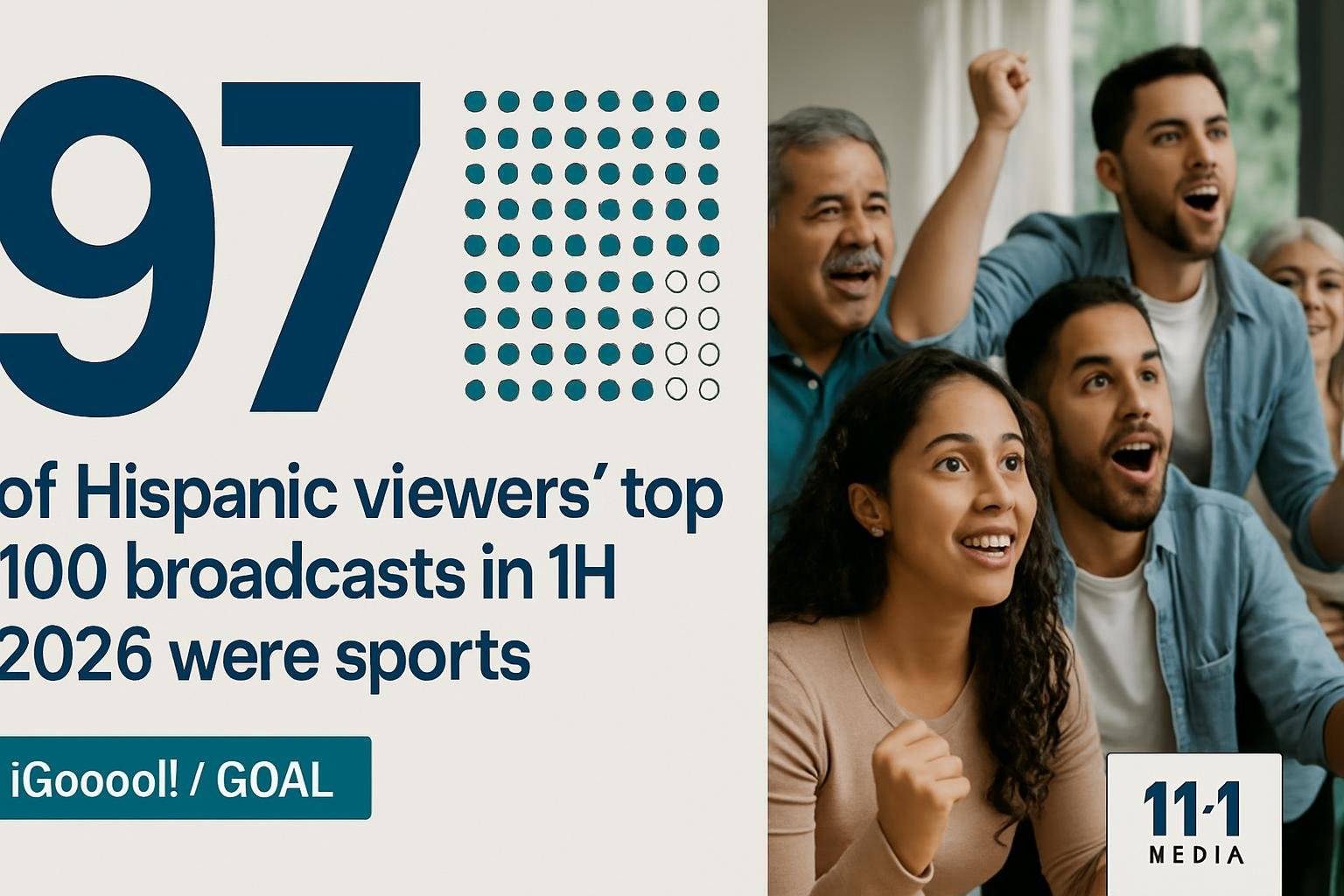
If your media plan still sorts Hispanic audiences into a “Spanish-language” box that sits apart from the “general market” box, Nielsen’s newest research is a good reason to revisit that structure. In September 2026, Nielsen released the Hispanic edition of its Diverse Intelligence Series, covering the first half of 2026. One number is doing most of the traveling: of the top 100 broadcast telecasts among Hispanic viewers, 97 were sports.
That single figure is useful, but it is easy to over-read. Below is what the research actually reports, what it does not establish, and how we at 11-11 Media would translate it into decisions for Hispanic sports marketing and broader audience planning.
What Nielsen reported
Sports dominated Hispanic viewing in the first half of 2026
- 97 of the top 100 broadcast telecasts among Hispanic viewers in 1H 2026 were sports programming (Nielsen).
- 149 billion minutes of sports programming watched across linear TV and live streaming (Nielsen NPOWER, Live+7, 1H 2026).
- 57 billion minutes of World Cup programming in five and a half weeks — on linear television alone (Nielsen NNTV, Panel, Live+SD, 6/11–7/19/2026).
- Soccer led broadcast television with nearly 50 billion minutes, followed by football (13 billion) and basketball (9 billion), as reported by Media Play News.
- Hispanic share of the Super Bowl audience reached 16.4%, up from 14.4% a year earlier (Nielsen Big Data + Panel, Super Bowl LIX and LX).
The growth was not limited to soccer
Per trade coverage of the report, Hispanic viewing of the College Football Playoff national championship rose more than 80%. Hispanic viewers made up 20.6% of the World Baseball Classic final audience — about 2.1 million viewers, up 61.5% from the 2023 final. Roughly 760,000 Hispanic viewers watched the NCAA Division I women’s basketball championship, up 65%. IndyCar’s Hispanic viewership grew 64%.
Language lines were more porous than the org chart assumes
This is the part most relevant to media buying. Nielsen’s chapter frames the World Cup as an event watched “in two languages,” and outside reporting puts numbers on the crossover:
- Telemundo, citing Nielsen, said roughly half of U.S. World Cup viewers watched at least part of the tournament in Spanish — in a country where about 20% of the population is Hispanic (AP via PBS News).
- According to Nielsen ratings, 20% of Telemundo’s World Cup viewers speak English as their primary language, and Telemundo/Peacock averaged 4.6 million viewers per match (NPR).
Nielsen’s Stacie de Armas summarized the pattern this way: “Hispanic audiences arrived first to nearly every big moment of 2026, and America showed up right behind them… culturally specific moments naturally transcend language barriers and drive viewership that extends beyond the Hispanic community” (Media Play News).
What the data does not say
Being precise here protects your budget:
- It is a ranking, not a preference test. “97 of the top 100” describes the largest broadcast telecasts in a half-year that contained a World Cup, a Super Bowl, and a World Baseball Classic. It does not mean Hispanic audiences only watch sports. Nielsen separately reports that Hispanic households watched more than 2 trillion minutes of content in the same period, across a much wider mix.
- Minutes are not intent. Attention volume tells you where to show up. It does not tell you that a given creative, offer, or landing page will convert.
- Language behavior is contextual. Choosing a Spanish-language feed for a World Cup match is not evidence that the same person prefers Spanish for a mortgage explainer or an HVAC service call.
- The full report is gated. The figures above come from Nielsen’s public report page (which lists its own data sources) and independent coverage of the release. The complete chapter PDF requires a form submission.
What we recommend you do with it
The following are 11-11 Media’s recommendations, not Nielsen findings.
1. Budget around moments, not just demographics
If sports account for a disproportionate share of Hispanic broadcast attention, then a small number of dated events can deliver reach that always-on flighting cannot. Build a 12-month moment calendar — Liga MX and CONCACAF fixtures, NFL and college football, playoff baseball, boxing cards — and reserve budget against those dates before spreading the remainder.
2. Stop treating Spanish-language inventory as a “Hispanic-only” buy
When one in five Telemundo World Cup viewers is English-primary, Spanish-language sports inventory is functioning as broad-reach inventory during marquee events. Ask your media partner to report Spanish-language placements against total reach and efficiency, not only against a Hispanic sub-target.
3. Match language to the moment, not to the person
Bilingual households are not one audience with one setting. A practical approach: culturally specific, Spanish-forward creative for event-driven awareness; English or bilingual assets for consideration and service content, where clarity and comparison shopping dominate. Test the pairing rather than assuming it.
4. Make sure the destination matches the ad
Event media drives spikes to your site, phone, and DMs. If the ad is in Spanish and the landing page, intake form, or after-hours voicemail is English-only, you have paid for attention you cannot serve. Audit the whole path — including reviews, hours, and Google Business Profile — before the next big fixture.
5. Watch early signals inside your own data
Nielsen’s third chapter argues Hispanic audiences reach new content first and that week-one viewing signals what the rest of the country watches next. You can look for the local equivalent: which segments of your customer base adopt a new product, promotion, or channel first, and whether broader demand follows.
The broader context for Houston businesses
Nielsen puts the U.S. Hispanic community at 19% of the population, up 23% over the past decade against 7% national growth, with purchasing power it cites at $4.1 trillion (credited to the Latino Donor Collaborative, 2025) — Nielsen. In markets like Houston, that share is higher still, which changes the arithmetic: a plan built to reach Hispanic households is often simply a plan built to reach your market.
Just as important is what these numbers do not license. Hispanic audiences in the U.S. span multiple national origins, generations, income levels, and language profiles. Aggregate viewing data describes a population’s behavior in a specific half-year; it is not a personality profile, and it should never be used as a substitute for talking to the customers you actually want.
Let’s pressure-test your plan
11-11 Media is a Hispanic marketing firm in Houston. If you want a second read on how your media calendar, creative, and conversion path line up with where Hispanic attention is actually going, get in touch with our team — bring your current plan and we will tell you honestly what we would change and what we would leave alone.