
If you sell building materials, tools, or trade services, a large and identifiable share of your customer base may already be standing at your counter — while your marketing is still built as though it weren’t. Federal labor data shows Hispanic workers now make up more than a third of U.S. construction employment. Census data shows construction is the single largest sector for Hispanic-owned employer firms. And the industry’s own benchmark report shows dealers fighting for share in a market that barely grew.
Below is what those three data sets actually say, followed by what we at 11/11 Media recommend doing about it. We keep those two things separate on purpose.
The market context: flat sales mean growth has to come from share
The 2026 Construction Supply 150 from Webb Analytics reports that America’s largest lumber and building material dealers rang up $424.25 billion in 2025 — a gain of just 1.4%. Remove The Home Depot and Lowe’s, and the rest of the group’s sales fell 1.2%. Branch counts tell a similar story: up 10% collectively, but only 2.5% once you exclude the pro dealers the two big boxes acquired.
Two more figures from that report belong in any marketing conversation. The Home Depot spent $1.3 billion on advertising in 2025; Lowe’s spent $978 million. And the pro/retail line is dissolving — the report notes The Home Depot now says pros generate 50% of its revenue, with Lowe’s estimating 40%.
What it means for marketing decisions: regional dealers and specialty suppliers cannot outspend that. When budget parity is impossible, relevance and service are the levers that remain — and relevance starts with knowing precisely who is specifying, buying, and installing your products.
Who is on the jobsite: the workforce evidence
According to Bureau of Labor Statistics Current Population Survey 2025 annual averages by detailed industry, 12.1 million people were employed in construction and 35.4% were Hispanic or Latino. Looking at construction and extraction occupations specifically, the share is 41.7%.
Concentration varies sharply by trade
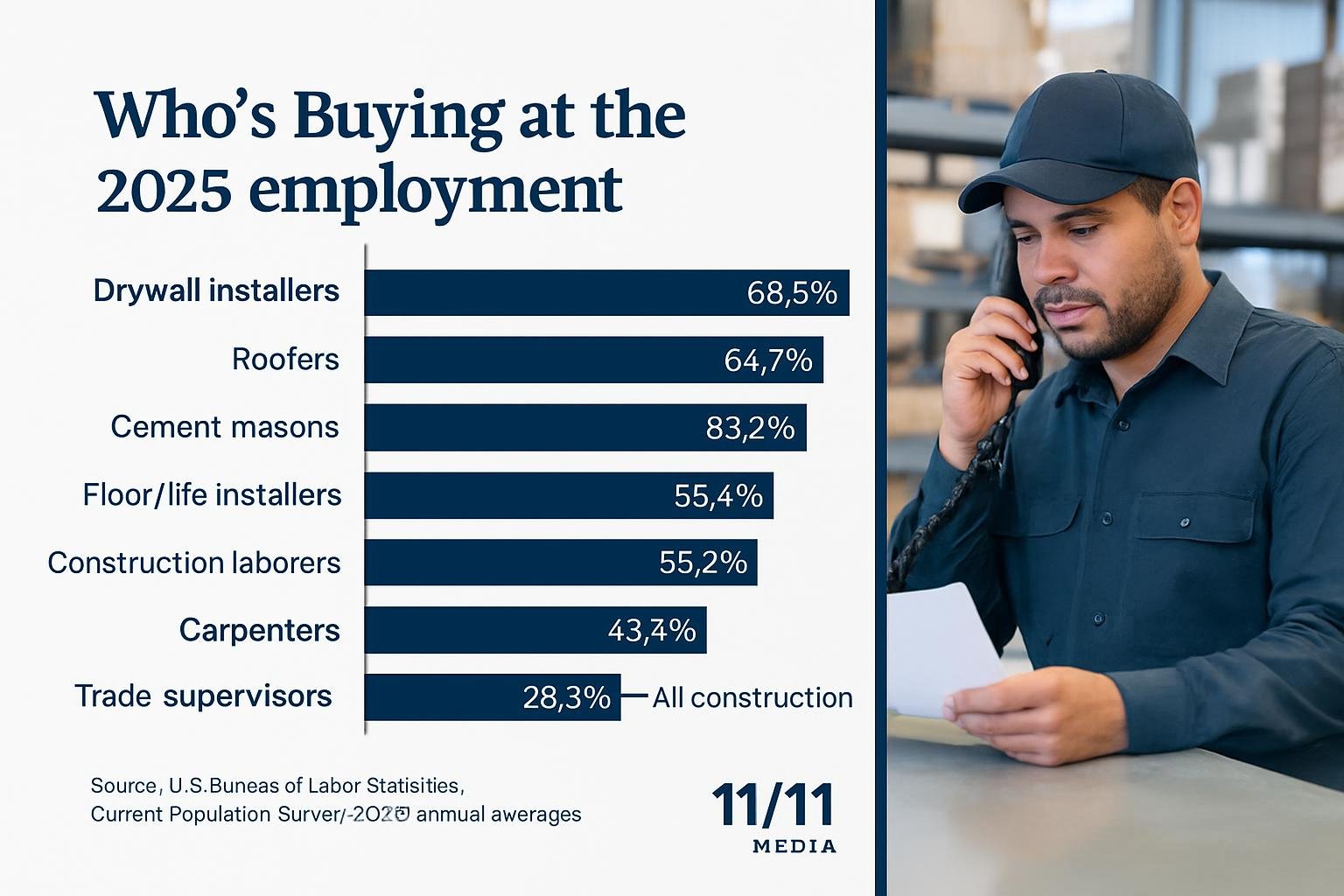
The aggregate number hides the detail that matters for targeting. In 2025, the Hispanic or Latino share of employment was:
- Drywall and ceiling tile installers and tapers — 68.5%
- Roofers — 64.7%
- Cement masons, concrete finishers and terrazzo workers — 63.2%
- Carpet, floor and tile installers and finishers — 55.4%
- Construction laborers — 55.2%
- Carpenters — 43.3%
- First-line supervisors of construction trades — 28.3%
- Construction managers — 20.1%
The distribution channel shows the same pattern in milder form: Hispanic or Latino workers were 24.6% of employment at lumber and other construction materials merchant wholesalers and 20.0% at building material and supplies dealers (excluding hardware retailers).
One methodological caveat the BLS itself flags: 2025 annual estimates are 11-month averages that exclude October, because data were not collected during the federal shutdown, and they use a new industry classification — so they are not strictly comparable with earlier years.
What it means for marketing decisions: a single undifferentiated “Hispanic campaign” is too blunt an instrument. Representation is highest in specific trades and lower in supervisory and management roles, which means the installer, the foreman, and the person who chooses the supplier are often three different people with different information needs. Segment by trade first, then by role.
Hispanic-owned firms are a buying segment, not just a labor pool
This is the point most building-products marketing misses. Census Bureau Annual Business Survey data show that construction was the top sector for Hispanic-owned employer firms, with 70,571 firms. Nationally there were 406,086 Hispanic-owned employer firms in 2021 — about 7.1% of the country’s 5,681,118 employer firms — generating $572.9 billion in revenue, or 3.3% of the total. In Texas, 63,560 firms, or 14.6% of the state’s employer firms, were Hispanic-owned. For context on our own market, Census QuickFacts puts the Hispanic or Latino share of the Texas population at 40.9%. Note that these ABS figures cover employer firms only and therefore exclude a large population of self-employed trade contractors.
What it means for marketing decisions: these are businesses that open credit accounts, schedule deliveries, dispute invoices, and pay bills online. They are buyers, not just labor. The CS150 report notes that 46% of responding dealers now have CRM software — up from 27% in 2022 — and 69% let customers pay bills online. Those systems are where a pro-account strategy either works or quietly fails.
Language is a targeting variable, not an on/off switch
Pew Research Center’s 2024 report How Hispanic Americans Get Their News found that 54% of Hispanic adults get news mostly in English, 21% mostly in Spanish, and 23% in both about equally; preferences track closely (51% English, 24% Spanish, 23% no preference). Among Latino immigrants the picture inverts: 41% get news mostly in Spanish and 47% prefer Spanish. Platform behavior is decisive — 87% get news from digital devices at least sometimes, and 65% prefer digital over TV, radio, or print. Half at least sometimes use Hispanic news outlets, including 69% of immigrants versus 33% of U.S.-born Hispanics. Separately, Pew found that 75% of Latinos can hold a conversation in Spanish and 63% use Spanglish at least sometimes.
Important limit: this research measures news consumption, not supplier selection. Treat it as directional evidence about language and platform, not as proof of purchasing behavior.
What it means for marketing decisions: English-only and Spanish-only are both wrong defaults. The evidence supports English-first digital content with genuine Spanish capability at the moments that carry risk or money — product specs, safety and installation guidance, credit terms, delivery coordination, and warranty claims.
Our recommendations (distinct from the findings above)
The following are 11/11 Media’s recommendations, inferred from the evidence. They are not findings of the cited reports, and we are not promising a specific outcome from any of them.
- Segment by trade and role before language. Build separate content tracks for the trades where the data shows the highest concentration, and write differently for installers than for owners and estimators.
- Make Spanish functional, not decorative. Prioritize installation instructions, jobsite safety material, credit applications, and delivery communications over translated brand slogans.
- Lead with digital and mobile. Pew’s platform data points to phones. Pricing, availability, order status, and invoices should be usable on a phone, in the field, one-handed.
- Merchandise the services, not just the SKUs. The CS150 report shows half of its members offer installed sales, worth $7.69 billion, or 11% of revenue, for the 86 members with value-added programs — and it notes builders value it partly because it eases their labor burden. Market that capability explicitly to contractor accounts.
- Capture language preference as a field in your CRM. Not as an assumption based on a name. Ask once, store it, and route quotes, texts, and service calls accordingly.
- Train the counter and the delivery team. The most frequent brand experience in this channel is a two-minute conversation at a will-call window, not an ad.
How to judge whether it is working
Set your measurement up before launch, and keep the claims honest:
- Track new pro account applications and first-90-day order frequency by segment, not just impressions.
- Instrument the Spanish-language paths separately so you can see whether they are used at all.
- Watch quote-to-order conversion and return/callback rates as quality signals.
- Expect long, noisy, multi-touch cycles in a channel where the CS150 reports 95 of 111 forecasting dealers expect gains in 2026 while actual 2025 growth was 1.4%. Optimism is not a baseline.
What this data does not say
Workforce composition is not a personality profile. Nothing here supports assumptions about any individual’s language ability, income, credit, buying authority, or media habits — and the Pew data specifically shows a majority of Hispanic adults preferring English, with immigrant and U.S.-born respondents differing sharply. Hispanic contractors and buyers are not one audience. The CS150 report contains no ethnicity or language data at all; we used it for market and channel context only. Any claim that a specific creative approach will lift sales in this channel would be speculation, so we have not made one.
Let’s look at your accounts
If you supply the trades in Houston or across Texas and want to know whether your marketing matches the people actually buying from you, we can help you audit it — segment by segment, language by language, counter to CRM. See how we work on our services page, or contact 11/11 Media to start the conversation. You can also reach us at info@11-11media.com or (832) 650-0000.