
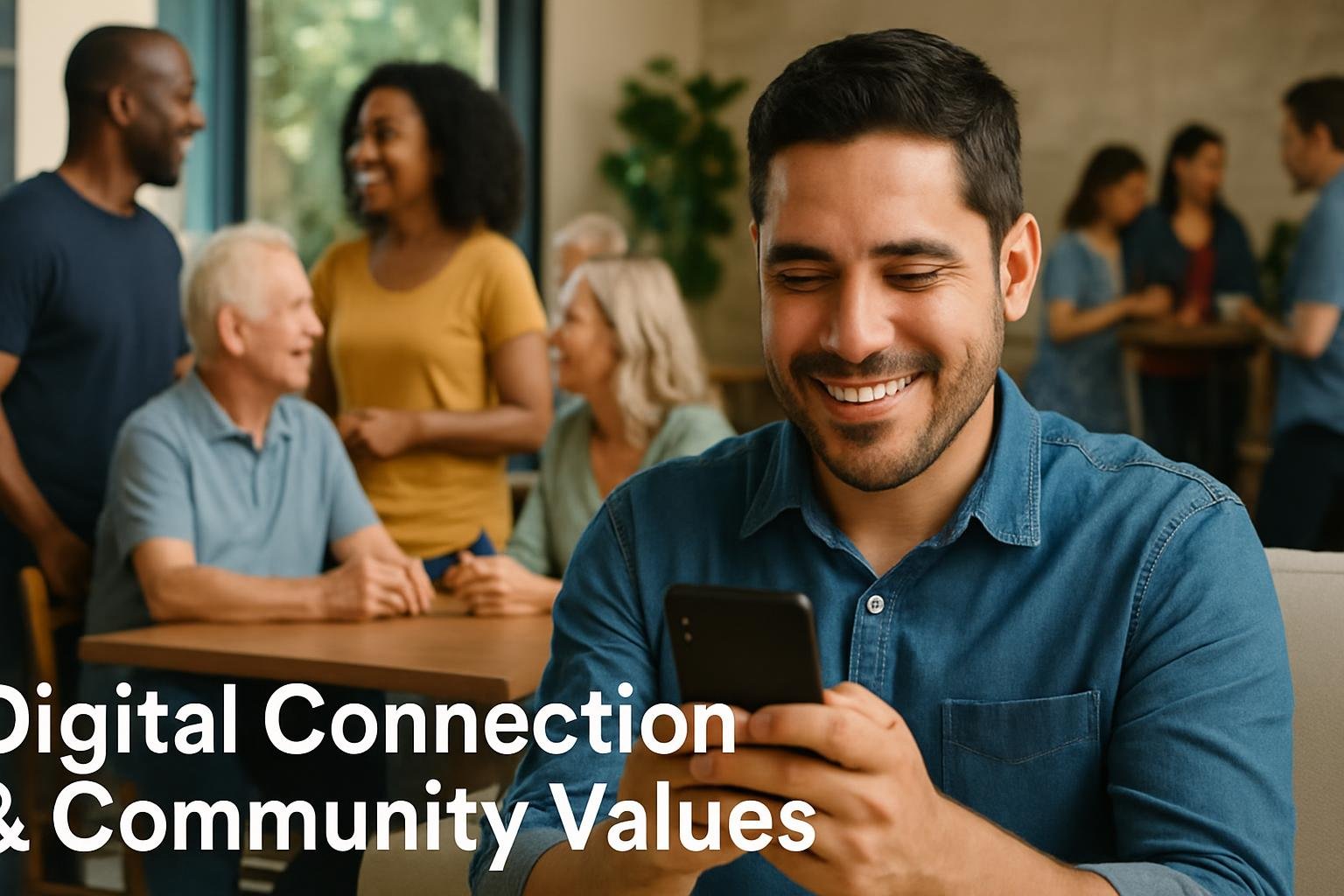
Where do your customers go when they want trusted advice, local updates, or a sense of belonging? Increasingly, the answer involves a blend of digital spaces and real-world gatherings. From neighborhood messaging threads to faith-based apps and hobby forums, online communities have become an everyday part of how millions of Americans share information and make decisions.
For business owners and marketing leaders aiming to reach Hispanic audiences, understanding how digital communities function—including spaces centered on faith, local neighborhoods, and shared interests—offers valuable perspective. Recent data from the Pew Research Center highlights both the reach of online communities and their limits: while digital platforms are powerful engines for daily information and recommendations, most people still view in-person relationships as irreplaceable.
Below, we break down the verified findings from Pew Research Center’s latest reports on online communities and digital religious engagement, followed by practical takeaways on what this data means for your marketing strategy.
What the Research Shows: Online Communities in America
In October 2026, Pew Research Center released Online Community and Connection in America, a national study from the Pew-Knight Initiative based on a survey of 9,750 U.S. adults conducted in May and June 2026. The report examined how Americans connect with others online by joining groups, participating in forums, or messaging regularly around shared themes.
According to the full report and appendix data, 36% of U.S. adults say they are part of an online community, including 32% of Hispanic adults. Participation is strongly tied to age: 48% of adults ages 18 to 29 and 40% of adults ages 30 to 49 belong to an online community, compared with 32% of those ages 50 to 64 and 26% of adults 65 and older.
Where People Gather and What They Discuss
Online communities do not exist in a single digital corner. Across all U.S. adults surveyed in 2026, the most common platforms for online community participation include:
- Social media sites or apps such as Facebook, Instagram, or TikTok (26% of all U.S. adults, and 81% of online community members)
- Online discussion forums such as Reddit, Nextdoor, or Discord (15% of all adults)
- Video platforms such as YouTube or Twitch (11% of all adults)
- Messaging apps such as WhatsApp (10% of all adults, and 51% of online community members)
- Online video games (10% of all adults)
When asked what kinds of online communities they belong to, Americans most frequently point to hobbies (23%) and their local area (21%). Other notable topics across all U.S. adults include movies, books, or TV shows (13%), work or profession (12%), video games (12%), fan communities (12%), and physical or mental health (11%). In addition, about one-in-ten Hispanic adults say they are part of an online community specifically related to race and ethnicity.
Why Members Show Up—and Why They Leave
For those who participate in online communities, these spaces are a daily habit. Pew Research Center found that 85% of online community members belong to more than one group, and 56% visit their most-frequented community every day. Furthermore, 74% actively post or share content in their primary community, and 63% say it provides something they could only find online.
When looking at what motivates members to visit their go-to online community (combining major and minor reasons), three practical drivers top the list:
- To stay informed: 86% (57% major reason)
- For fun: 82% (54% major reason)
- To get advice or recommendations: 78% (42% major reason)
At the same time, the research highlights healthy skepticism about purely digital relationships. Nearly half of U.S. adults (47%) say personal relationships formed online are not as meaningful as in-person ones, while 34% say they can be just as meaningful (though among adults under 30, 54% view online relationships as equally meaningful). Notably, 36% of online community members say their most-visited online group also holds in-person gatherings, showing that many successful digital groups bridge the gap into the physical world.
Maintaining community quality is also critical. About a third of U.S. adults (34%) have left an online community. According to the report’s findings on community departures, people most often leave because they lost interest (85%), the community was not as good as it used to be (71%), their life changed (61%), or there was too much arguing (57%). In fact, 54% of online community members say political discussion does not belong in the community they visit most often.
Digital Faith and Spirituality: A Closer Look at the Data
Pew Research Center’s October 2026 survey found that 8% of all U.S. adults (and 22% of those who participate in online communities) belong to an online community related to religion or spirituality. For 4% of online community members, religion or spirituality is the main focus of the single community where they spend the most time.
While the 2026 report does not break down religious online community membership specifically by Hispanic ethnicity, an earlier, comprehensive Pew Research Center study provides detailed demographic insight into how Hispanic adults use digital technology in their religious lives. Conducted in November 2022 among 11,377 U.S. adults and published in June 2023, Online Religious Services Appeal to Many Americans, but Going in Person Remains More Popular examined virtual worship and digital faith habits across racial and ethnic groups.
Key verified findings from that report and its chapters on virtual religious services and apps and websites in religious life include:
- Regular Virtual Viewing: 30% of Hispanic adults reported watching religious services online or on TV at least monthly (compared with 27% of U.S. adults overall, 48% of Black adults, and 22% of White adults).
- Active Engagement at Home: Hispanic virtual viewers were significantly more likely than White viewers to participate actively rather than watch passively. Among Hispanic adults who regularly watched services on screens, 47% said they usually did things they would normally do in person—such as praying out loud, singing, or kneeling—all or most of the time (compared with 32% of White viewers). One-third (33%) of Hispanic regular viewers said they felt like an active participant during virtual services, compared with 18% of White viewers.
- Mobile Apps for Scripture and Prayer: One-quarter (25%) of Hispanic adults reported using apps or websites to help or remind them to read scripture (compared with 21% of U.S. adults overall and 17% of White adults). Additionally, 20% of Hispanic adults used apps or websites to help or remind them to pray (compared with 14% of all U.S. adults and 10% of White adults).
- In-Person Worship Still Leads: Even with strong digital adoption, physical gathering remained the gold standard. Among Hispanic adults who both attended services in person and watched online regularly, 68% said they preferred attending in person, while 16% preferred watching online.
What These Findings Mean for Marketing Decisions
Note: The following insights represent 11/11 Media’s strategic marketing recommendations based on the research above, rather than direct findings from Pew Research Center.
When business owners look at data on Hispanic audiences, it is essential to avoid treating the market as a monolith. Not every Hispanic consumer belongs to a faith-based group, uses WhatsApp, or participates in an online forum. However, combining the 2026 online community data with the 2023 religious technology data reveals clear behavioral patterns that can guide smarter marketing decisions.
1. Prioritize High-Utility, Advice-Driven Content
In Pew Research Center’s 2026 study, 86% of online community members cited staying informed and 78% cited getting advice or recommendations as reasons they visit their primary community. Whether your brand participates in local neighborhood groups, professional forums, or social media communities, promotional broadcasts rarely gain traction. Marketing decision-makers should focus on creating educational, problem-solving content—such as bilingual how-to guides, local resource checklists, and transparent FAQ videos—that community members naturally want to share when peers ask for recommendations.
2. Respect Values Without Relying on Stereotypes
The data shows that a meaningful segment of Hispanic adults actively uses digital tools—from video streams to mobile apps—to support their spiritual habits and community ties. At the same time, religiosity and denominational traditions vary widely across generations and households. Unless your organization is directly offering faith-based products or services, forcing religious imagery into commercial campaigns can feel inauthentic. Instead, brands can align with the underlying values that sustain strong communities: family well-being, mutual support, respect, and trustworthiness.
3. Bridge Digital Engagement with Local, In-Person Touchpoints
Both Pew Research Center studies underscore a vital truth: digital tools supplement, rather than replace, face-to-face connection. Just as 68% of Hispanic dual-worshippers in the 2023 survey preferred in-person services, 47% of Americans in the 2026 survey said online relationships are not as meaningful as in-person ones—and more than a third of online communities host real-world meetups.
For local and regional businesses, digital marketing works best when it connects to tangible community presence. Sponsoring neighborhood events, hosting in-person workshops, and using social media or messaging channels to keep local attendees connected afterward helps build the kind of trust that screen-only advertising cannot replicate.
4. Protect Community Tone and Relevance
Because declining quality, excessive arguing, and unwanted political debates are major reasons people abandon online spaces, brands managing their own Facebook Groups, WhatsApp communities, or comment sections must invest in active moderation. Clear community guidelines that keep conversations helpful, respectful, and focused on shared local or lifestyle interests will help retain engaged members over the long term.
Build Authentic Connections with 11/11 Media
Reaching Hispanic consumers requires more than translating ad copy or guessing which platforms your audience uses. It takes a strategy grounded in real research, cultural understanding, and genuine community connection. At 11/11 Media, our Houston-based team helps businesses develop culturally relevant branding, bilingual SEO, video production, and social media strategies designed to earn lasting trust.
If you are ready to align your digital presence with how your audience actually searches, connects, and makes decisions, contact 11/11 Media today to start the conversation.