
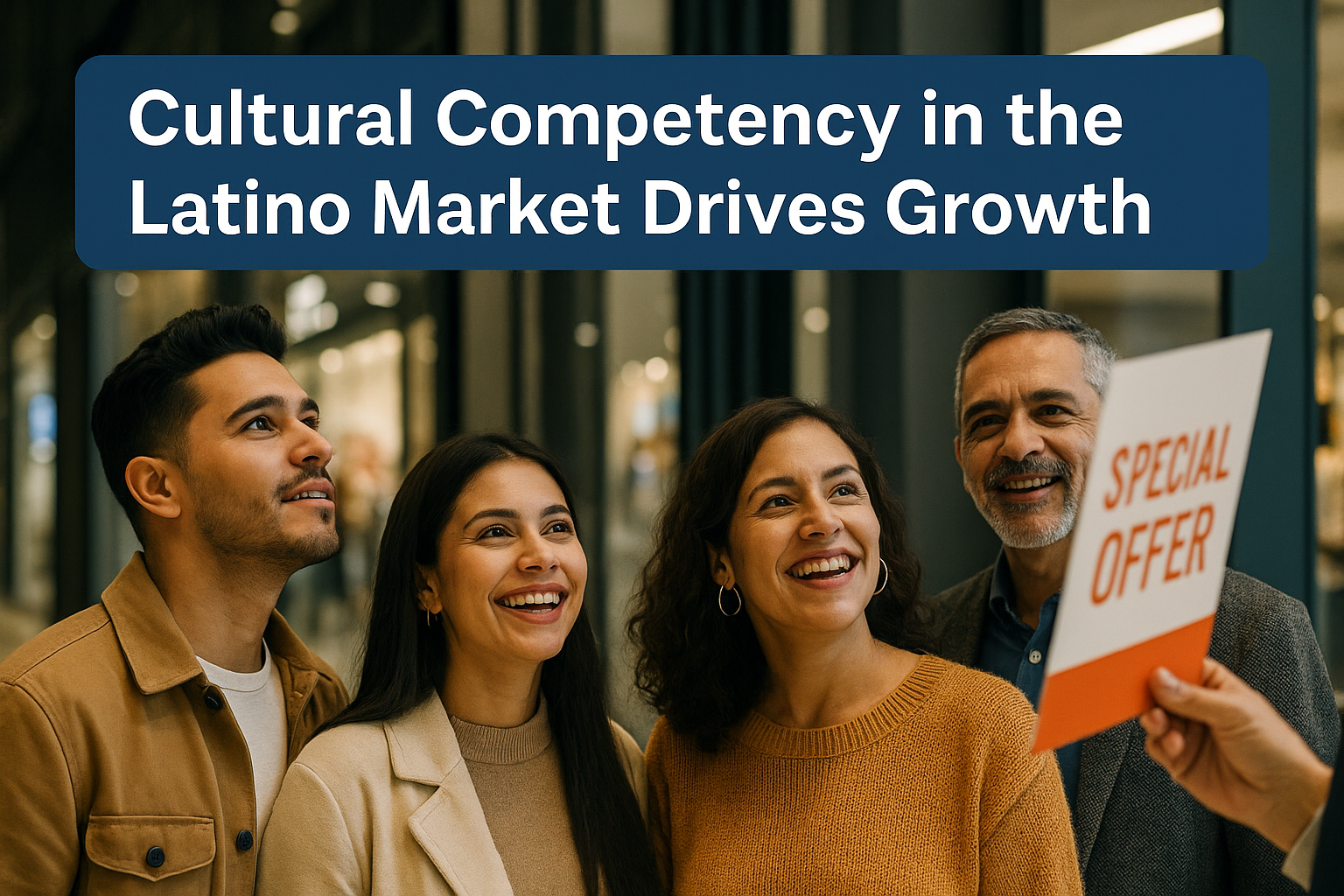
Why Cultural Competency in the Latino Market Is a Business Imperative
Cultural competency and authentic engagement are not optional—they are essential drivers of economic growth within the U.S. Latino market. By understanding and valuing cultural nuances, brands can build deeper connections, influence purchasing decisions, and significantly increase sales and market share.
1. Business Imperative for Growth
In 2022, U.S. Latinos generated a staggering $3.6 trillion in GDP—ranking as the 5th-largest economy in the world, surpassing India, the U.K., France, and Canada Even more compelling, the Latino GDP is projected to surpass Japan in 2024 and Germany by 2027, potentially becoming the world’s 4th-largest economy by 2029
Despite representing roughly 19% of the U.S. population, Latinos contributed 41% of U.S. real GDP growth between 2019 and 2022. They accounted for 28% of all national GDP additions over that period. This underscores that multicultural marketing is fundamentally about sales and business growth—not just a DEIB checkbox.
2. Consumer Demand for Authenticity
Cultural competency is the linchpin of brand success. Superficial “Latino Coating”—shallow marketing that lacks genuine relevance—fails to resonate with the market.
- 64% of Hispanic consumers actively seek brands that acknowledge their culture and unique traditions, versus 48% of the general population.
- 58% of Latinos say their heritage influences purchase decisions, compared to 48% of non-Hispanic consumers.
- Among Gen Z and Millennials specifically, 88–89% expect brands to meaningfully embrace diversity and inclusion.
In an age marked by heightened social awareness, especially among younger generations (Gen Z and Gen Alpha)—who are about 50% ethnically diverse—brands that misstep can face active backlash or boycotts.
3. Purchasing Behavior & Brand Loyalty
When brands connect authentically, Latino consumers respond emphatically:
- 57% cite respect for their Latino heritage as a reason for loyalty.
- 58% say culture, heritage, and background guide their buying decisions kantar.com.
Specifically, in sports sponsorship:
- Latinos are 39% more likely to recommend a sponsoring brand.
- They are 37% more likely to remain loyal to sponsors
- They are 32% more likely to consider a brand for the first time if it sponsors an event.
- They are 29% more likely to choose a sponsor’s product over a non-sponsor, all else equal .
- They are 11% more likely to purchase after encountering sponsor content
Hispanic podcast audiences also demonstrate rapid engagement—significantly higher click-through and purchase rates compared to general podcast listeners.
4. Winning Through Cultural Intelligence: Campaign Case Studies
Real-world examples show cultural-savvy campaigns deliver measurable ROI.
a) BeautifulBeast: “Amor with No BS” (Match Group – Chispa)
A Grand Prix-winning Off-Broadway reimagining of Shakespeare through a bold Latino lens, this campaign fought stereotypes and strengthened narrative ownership—deepening cultural resonance.
b) Ogilvy: “Whatever you call it, IKEA has it” (IKEA)
This campaign embraced linguistic diversity—not just literal Spanish translation—by launching IKEA’s first full Spanish-language e-commerce site, driving a 165% jump in sessions and 113% spike in online sales in one month.
c) alma: “Late” (Memorial Sloan Kettering Cancer Center)
By reframing the “Latino Standard Time” trope into a vital health message about screenings, this campaign achieved higher colorectal and breast cancer screenings in Latino communities.
d) Relevant+, Inc.: “A Savings Bucket to Honor You” (Ally Financial)
Using deeply felt cultural insight—honoring parents’ sacrifices—this music-driven storytelling boosted brand affinity by 30%, purchase intent by 27%, and recommendation intent similarly.
5. Your Roadmap to Authentic Engagement
To fully tap the Latino market’s potential, brands should implement these strategies:
- Invest in Cultural Competency
Use quantitative and qualitative insights to deeply understand sub-cultural nuances, not just performative diversity. - Commit to Long-Term Engagement
Avoid episodic outreach around Hispanic Heritage Month. Make Latino consumers a year-round priority. - Speak Culture and Language
Go beyond translation—use Spanglish, regional vernacular, and fluid code-switching that feels lived-in. - Follow the Multigenerational Path
Engage all household members—from abuelas to digital-native teens—to leverage the family dynamic. - Sponsor Community Experiences
Invest in events, sports, influencers, and podcasts that matter to Latino audiences. - Lead with Stories
Narrative ownership is creative bravery—tell stories by Latinos, for Latinos.
6. ROI: Authenticity as Profit
When brands embrace cultural competency, ROI follows:
- Higher loyalty: 57% loyalty tied to heritage respect; sports sponsorship boosts consideration by ~32%–39%.
- Sales lift: Donate to culture-forward campaigns and see purchase rates rise by 11%–29%.
- Digital amplification: Latino fans more likely to recommend and share—social engagement increases by up to 37%.
Conclusion
Cultural competency and authentic engagement are strategic imperatives, not optional marketing tools. They catalyze meaningful connections, powerful purchasing behavior, and sustained loyalty in the rapidly growing Latino market—an economic force projected to exceed $4 trillion by 2023, surpass Japan by 2024, and become the 4th-largest global economy by 2029
Brands that invest in true cultural understanding—through data, storytelling, language, and multi-generational engagement—will not only resonate; they’ll win. Let’s Win Together