
Many corporate marketing teams still treat Hispanic marketing strictly as a consumer-facing discipline. While household purchasing power remains vital, focusing exclusively on retail consumers overlooks one of the fastest-growing segments of the American commercial economy: Latino-owned employer businesses.
In March 2026, the Stanford Latino Entrepreneurship Initiative (SLEI) at Stanford Graduate School of Business and the Latino Business Action Network (LBAN) released the 11th annual 2025 State of Latino Entrepreneurship (SOLE) Report. Drawing on U.S. Census Bureau Annual Business Survey (ABS) benchmarks from 2017 to 2023, a national survey of more than 10,000 employer firms, a January 2026 pulse survey, and PitchBook venture capital data, the full Stanford research report (PDF) offers a comprehensive look at how Latino business owners are scaling, adopting technology, and navigating capital markets.
For commercial banks, software providers, industrial suppliers, professional service firms, and agencies developing a B2B Hispanic marketing strategy, the findings challenge outdated assumptions about firm size, industry concentration, and technological maturity. Below, we break down what the Stanford data shows—and our strategic recommendations for B2B marketers.
What the Research Shows: Net New Firm, Revenue, and Job Growth
The SOLE report focuses specifically on employer firms—businesses with at least one paid employee beyond the owner and at least $10,000 in annual revenue. According to the report’s analysis of U.S. Census Bureau Annual Business Survey data (covering reference years 2017 through 2023), Latino-owned businesses (LOBs) have been the primary engine of net new employer business creation in the United States:
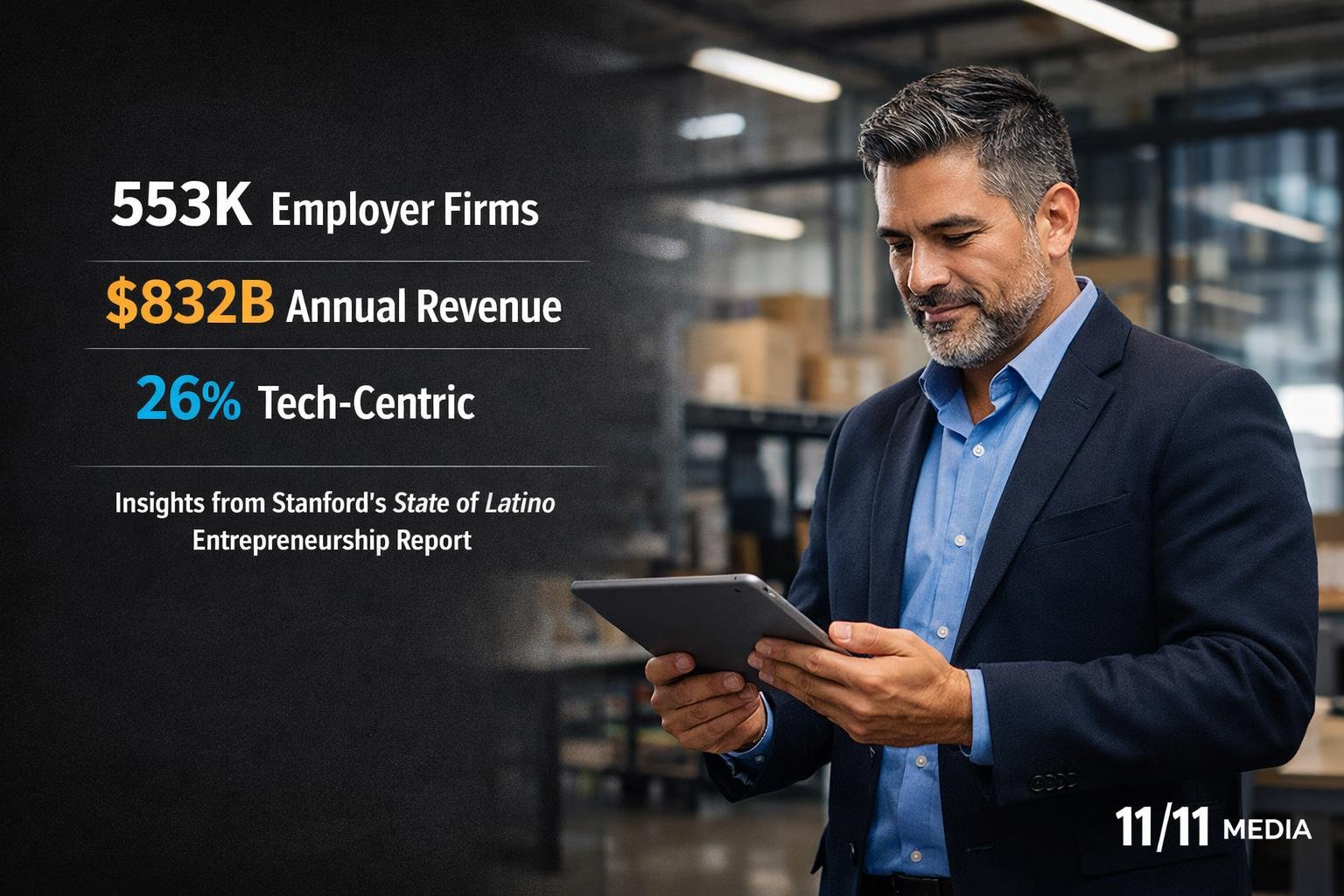
- 553,000 employer firms: By 2023, Latino-owned employer businesses accounted for 9.7% of all 5.7 million U.S. employer firms, generating $832 billion in annual revenue and employing 4.3 million workers.
- Outpacing peer firm creation: Between 2017 and 2023, the number of Latino-owned employer firms grew 48% (adding 180,000 net new firms), while non-Hispanic White-owned businesses (WOBs) declined by 3% (losing 140,000 firms).
- Revenue and employment momentum: Over the same six-year period, cumulative revenue among LOBs rose 68% (compared with 45% for WOBs), and employment grew 29% (adding 976,000 jobs, compared with 1% growth or 658,000 jobs for WOBs).
- The $1 million+ segment is accelerating: While roughly three-quarters of LOBs generate under $1 million in annual revenue, the share of scaled LOBs generating $1 million or more grew from 23% in 2017 to 26% in 2023 (reaching 145,000 firms)—an 86% cumulative increase in firm count.
- A $2.1 trillion parity opportunity: Because a large share of LOBs are younger firms (the number of LOBs under two years old jumped 76% between 2017 and 2023), average revenue per firm remains lower than that of older WOBs. The researchers estimate that if LOBs generated average revenue at parity with WOBs, it would add $2.1 trillion to the U.S. economy.
Texas and Major Hub Trends: Professional Services and Construction
Four states—California (118,000 LOBs), Florida (110,000), Texas (80,000), and New York (30,000)—account for 61% of all U.S. Latino employer firms, even as states with smaller baselines like Minnesota, Arkansas, and Wyoming see rapid percentage growth. As Stanford Report’s April 2026 coverage notes, LOBs accounted for more than 55% of all net new firms in California and Florida between 2017 and 2023.
For business leaders here in Houston and across Texas, the state-level industry breakdown is especially revealing. Between 2017 and 2023, overall Latino employer firm counts in Texas grew 39% (adding 22,000 net new firms), compared with flat (0%) growth rate for White-owned firms in the state. Across the top three industries in Texas, Latino-owned employer firms expanded rapidly:
- Professional, Scientific, and Technical Services in Texas: Grew 57% among LOBs (compared with 4% for WOBs)—the fastest growth rate in this sector among the four largest states.
- Construction in Texas: Grew 52% among LOBs (compared with 7% for WOBs). Nationally, Latino-owned construction firms grew 86% over the six-year period.
- Accommodation and Food Services in Texas: Grew 22% among LOBs (compared with 3% for WOBs).
Tech-Centric Operations, AI Adoption, and International Reach
One of the most persistent blind spots in B2B marketing is assuming that Latino-owned businesses operate only in traditional service or trade sectors. The 2025 SOLE survey data demonstrates strong technological and cross-border sophistication:
- 26% are tech-centric: More than one in four LOBs (26%, compared with 20% of WOBs) primarily build, develop, or sell software, hardware, or other technology products—up 7 percentage points since 2021. Despite being younger and smaller on average, tech-centric LOBs report median profit margins comparable to tech-centric WOBs.
- AI adoption has more than doubled: Across all industries, 47% of LOBs and 44% of WOBs reported using artificial intelligence in 2025, up from roughly 20% in 2024. Among tech-centric firms, AI adoption reaches roughly 70%. Primary use cases include marketing and content creation, data analysis and forecasting, and customer service, alongside responsible AI practices such as monitoring for risk or bias (38%) and staff training (36%).
- 49% operate internationally: Nearly half of U.S.-based LOBs (49%, versus 42% of WOBs) conduct international operations, with 57% of internationally active LOBs operating in Mexico. Even among smaller firms (under $1 million in revenue), 48% of LOBs operate across borders compared with 36% of WOBs, and international operations are associated with higher median profit margins that narrow the profitability gap with WOBs.
- Proactive growth mindset: LOBs achieved or were actively pursuing nine of ten measured growth strategies at higher rates than WOBs, including considering an acquisition (38% vs. 26%), progressing toward or launching a secondary venture or brand (44% vs. 31%), and pursuing strategic partnerships or joint ventures (43% vs. 31%).
Capital, Contracting, and Operational Friction
Understanding what keeps decision-makers up at night is essential for B2B positioning. In the 2025 survey, inflation topped the list of business challenges (cited by 37% of LOBs and 42% of WOBs), followed by competition (25%), taxes and government regulations (24% of LOBs), economic uncertainty (24% of LOBs), and slow business or marketing/finding customers (19% each). In SLEI’s January 2026 pulse survey, 65% of both groups expressed confidence in their business prospects over the next 12 months, even as 80% of LOBs reported that inflation had negatively affected their firm.
However, the research highlights three areas where Latino business owners experience acute friction:
- Financing and capital gaps at scale: Only 42% of LOBs seeking financing received the full amount requested, compared with 54% of WOBs. For loans of $1 million or more, only 22% of LOBs received full funding versus 45% of WOBs. Furthermore, 77% of LOBs who were denied or partially funded reported that lender explanations lacked specific reasons for the decision (versus 67% of WOBs). In venture capital, PitchBook data shows that while funded Latino startups achieved a $6 million median deal size in 2025 (above the $4.7 million U.S. median), overall Latino share of U.S. VC deal value was just 1.88%, and pre-seed/seed deal share dropped 79% from its 2020 peak (from 2.62% to 0.55%).
- Corporate and government procurement hurdles: While 40% of LOBs said corporate contracts were relevant to their business (versus 33% of WOBs), only 40% of those LOBs pursued them. LOBs rated navigating corporate contracting significantly more difficult across 11 of 13 dimensions—especially insurance and financial thresholds, compliance standards, and data/privacy requirements.
- Operational and policy pressures: LOBs were twice as likely to cite leadership or stakeholder misalignment (12% vs. 6%) and three times as likely to cite immigration enforcement as a challenge in summer 2025 (15% vs. 5%, rising to 35% vs. 14% reporting negative impact in the January 2026 pulse survey). Additionally, 67% of LOBs in the pulse survey said 2025 SBA loan fee changes affected their decision to apply for or accept SBA-backed financing.
What This Means for Marketing Decisions: Recommendations for B2B Brands
Note: The following points represent 11/11 Media’s strategic marketing recommendations based on the SLEI findings above, rather than direct conclusions from Stanford’s researchers.
1. Replace Small-Business Stereotypes with Growth-Oriented B2B Positioning
The data shows that Latino-owned employer firms are more likely than White-owned peers to be pursuing acquisitions, launching secondary brands, operating across borders, and building tech-centric products. B2B marketers selling enterprise software, commercial equipment, logistics, or advisory services should avoid patronizing “micro-business” messaging. Position your solutions around multi-location scaling, M&A readiness, cross-border operations, and cash-flow efficiency.
2. Compete on Transparency and Advisory Value in Financial and B2B Services
Because 77% of Latino business owners who experienced loan denials or partial approvals reported receiving no specific reasons for the decision—and more than one-fifth explicitly asked for clear funding criteria, recommended resources, and one-on-one consultations—banks, credit unions, fintech platforms, and commercial insurers have a clear differentiation opportunity. Content marketing and sales enablement that demystify underwriting criteria, SBA rule changes, corporate insurance requirements, and data-privacy compliance can build trust before a prospect ever fills out an application. In the SOLE survey, LOBs also emphasized high-quality service and customer experience (14% vs. 4% of WOBs) and employee well-being (13% vs. 7%) as core competitive strategies—values that relationship-driven B2B brands should mirror in their own account management.
3. Target High-Growth Regional Verticals with Culturally Grounded Creative
In Texas, Latino employer firm growth is surging not only in construction (+52%) and hospitality (+22%), but even more rapidly in professional, scientific, and technical services (+57%). Meanwhile, Stanford faculty co-director George Foster points out an increasing interface between tech and construction driven by physical infrastructure and data center demand. B2B campaigns in Houston and across Texas should segment audiences by industry vertical and operational maturity rather than treating “Hispanic business owners” as a single persona.
4. Build Co-Marketing and Partnership Channels
When navigating marketing and customer acquisition challenges, smaller LOBs rely on collaborations and partnerships—such as joint marketing and co-hosted events—at more than four times the rate of smaller WOBs (13% vs. 3%). B2B brands looking to reach Latino entrepreneurs can accelerate trust by co-creating educational workshops, regional industry events, and bilingual digital resources alongside established business networks and chambers.
Partner with 11/11 Media to Reach Hispanic Decision-Makers
Whether you are a B2B organization looking to connect with high-growth Latino business owners or a scaling enterprise ready to modernize your brand presence, executing an effective strategy requires more than literal translation. At 11/11 Media, our Houston-based team helps brands build authentic connections through culturally rooted brand development, SEO, video production, web development, and social media marketing.
Ready to align your marketing strategy with how today’s Hispanic business owners and consumers actually operate? Contact 11/11 Media today to start the conversation.